
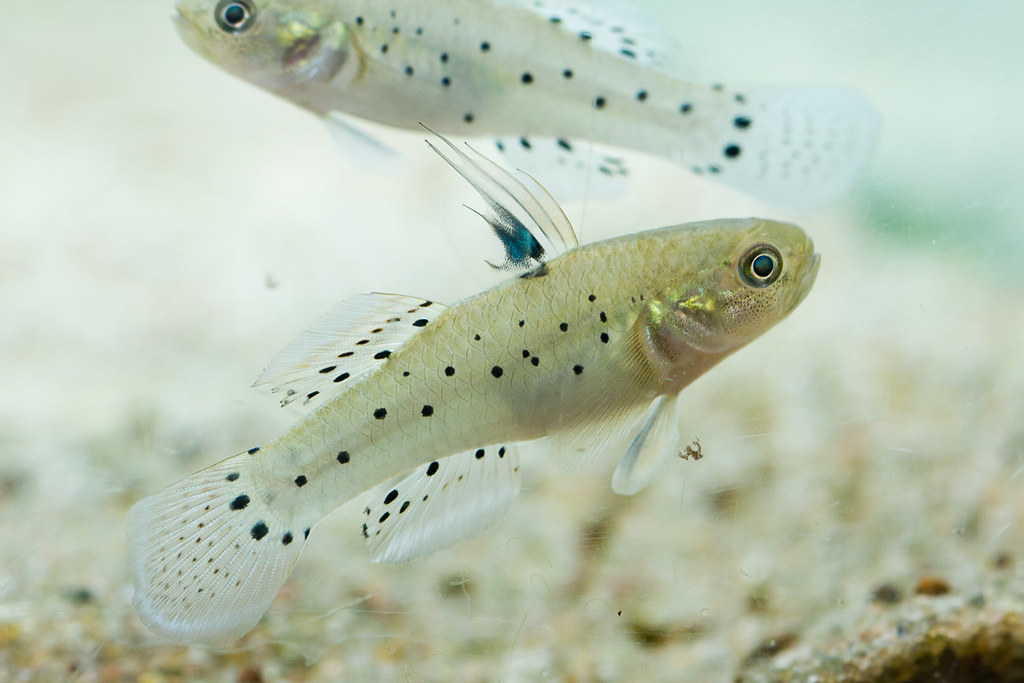
| Species Name | Stigmatogobius sadanundio |
|---|---|
| Common Name | Knight Goby, Fan Dancer |
| Care Level | Moderate |
| Lifespan | 5-8 years |
| Adult Size | Up to 3.5 inches (9 cm) |
| Diet | Carnivore |
| Minimum Tank Size | 30 gallons |
| Temperature | 72°F – 82°F (22°C – 28°C) |
| Water Conditions | pH 7.0-8.5, Brackish water with a specific gravity of 1.005-1.020 |
About the Knight Goby – Species Summary
The Knight Goby, with its scientific name being Stigmatogobius sadanundio, is a captivating brackish water fish that originates from the coasts and estuaries of Asia. Sporting an intriguing mix of spots and stripes on its body, it offers an attractive visual appeal to aquarists seeking something distinct. Unlike its pure freshwater counterparts, the Knight Goby thrives in environments where fresh and saltwater merge. With its protruding eyes and impressive coloration, this fish certainly stands out in the crowd.
Knight Goby Lifespan
With diligent care and an optimal environment, the Knight Goby can have a lifespan extending from 5 up to 8 years. A stable habitat, devoid of stressors and sudden changes, plays a significant role in ensuring its longevity.
Appearance
The Knight Goby is adorned with an ensemble of gray and black stripes running vertically down its body, interspersed with sporadic spots. These markings, combined with its uniquely protruding eyes, grant it a distinguished appearance. The eyes, perched on the top of its head, provide a panoramic view, enabling the fish to stay alert and vigilant.
Average Size
Upon reaching its full potential in size, the Knight Goby usually measures around 3.5 inches or roughly 9 cm.
Knight Goby Care
Tank Size
A minimum of a 30-gallon tank is recommended for the Knight Goby. Due to its moderately territorial behavior, ensuring ample space is crucial for its well-being.
How To Set Up Their Tank
A setup emulating their natural habitat would comprise sandy substrates, rocks, and caves for hiding. Live plants can also be included, though choose ones that can tolerate brackish conditions, such as Java fern. It’s essential to gradually acclimate them to the brackish conditions if they’ve been kept in freshwater initially.
Lighting Requirements
The Knight Goby doesn’t have specific lighting demands. Standard aquarium lighting that supports the overall ecosystem is usually adequate.
PH
A pH range of 7.0 to 8.5 is optimal for the Knight Goby.
Temperature
The temperature range suitable for Knight Gobies lies between 72°F and 82°F (22°C to 28°C).
Water Parameters
Brackish water conditions are ideal, with a specific gravity of 1.005-1.020. It’s advisable to use marine salt to achieve the desired salinity and to perform regular water tests to maintain consistency.
Disease Potential
The Knight Goby is not particularly disease-prone when compared to other aquarium fish. However, a drop in their immunity can make them susceptible to common fish ailments like Ich. A stable environment, quarantine practices for new tank mates, and regular observation can help in early detection and treatment.
Food & Diet
Being carnivorous, the Knight Goby’s diet primarily comprises live and frozen foods. Brine shrimp, bloodworms, and daphnia are among their favorites. Occasional high-quality flake or pellet foods enriched with essential nutrients can also be introduced.
Behavior and Temperament
Knight Gobies exhibit a semi-aggressive temperament, especially when confined in smaller spaces. They are territorial and might stake out their own zones within the tank, defending them against intruders. Their upturned mouths and top-set eyes indicate a bottom-dwelling nature, and they often sift through the substrate searching for food.
Tank Mates
Considering their territorial nature, it’s crucial to select tank mates with care. Fish that are peaceful and don’t invade the Knight Goby’s territory make for suitable companions. Mollies, larger tetras, and other brackish-tolerant species can coexist with them. Avoid housing them with very aggressive species or those small enough to be seen as prey.
Breeding
Breeding the Knight Goby in captivity can be a challenging venture. For a successful spawn, maintain slightly higher salinities. A separate breeding tank with plenty of hiding spots is recommended. Once the eggs are laid, usually in a secluded spot, it’s wise to remove the adults to protect the eggs from potential predation.