
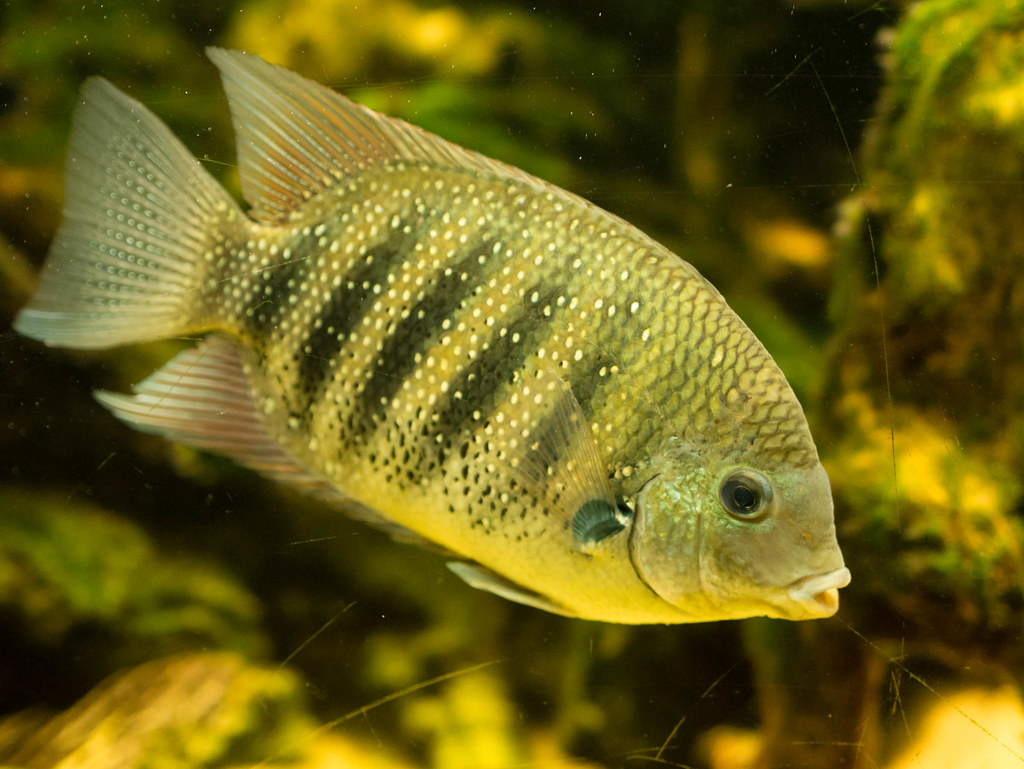
| Species Name | Etroplus suratensis |
|---|---|
| Common Name | Green Chromide, Pearl Spot Cichlid |
| Care Level | Moderate |
| Lifespan | Up to 8 years |
| Adult Size | 6-8 inches (15-20 cm) |
| Diet | Omnivore |
| Minimum Tank Size | 30 gallons |
| Temperature | 72°F – 82°F (22°C – 28°C) |
| Water Conditions | pH 6.8-8.2, Soft to Hard water |
About the Green Chromide – Species Summary
The Green Chromide, scientifically known as Etroplus suratensis and colloquially referred to as the Pearl Spot Cichlid, hails from the freshwater and brackish waters of India and Sri Lanka. Popular for its attractive coloration and relatively peaceful disposition, this cichlid makes an interesting choice for many aquarium enthusiasts. Residing primarily in backwaters and estuaries, the Green Chromide boasts an impressive adaptability which is reflected in its dietary habits, demonstrating both herbivorous and carnivorous tendencies.
Green Chromide Lifespan
Under optimal conditions and with proper care, the Green Chromide can live up to 8 years in captivity. A well-balanced diet, regular tank maintenance, and monitoring of water parameters play a crucial role in ensuring the longevity of this species.
Appearance
The Green Chromide, true to its name, exhibits a beautiful greenish body with tiny pearl-like spots across its entire length, giving it the moniker “Pearl Spot Cichlid.” A series of dark vertical bands can be seen, particularly prominent in younger individuals. Their dorsal and anal fins are elongated and have a yellow to orange hue, which becomes especially pronounced during breeding seasons.
Average Size
In a well-maintained aquarium setting, a Green Chromide typically grows to an adult size of between 6 to 8 inches (15-20 cm).
Green Chromide Care
Tank Size
For a pair of Green Chromides, a minimum tank size of 30 gallons is recommended. Given their active nature, larger tanks are beneficial, especially if the intent is to house a community of fish.
How To Set Up Their Tank
Model the tank based on their natural habitat — a mix of freshwater and brackish environments. A sandy substrate is essential, paired with rock formations, caves, and driftwood for hiding spots. Live plants can also be added, though choose hardy varieties that can withstand slightly brackish conditions, like Java fern or Anubias.
Lighting Requirements
Moderate lighting is suitable for Green Chromides, reflecting the dappled light of their natural estuarine environments.
PH
Maintain a pH level ranging between 6.8 to 8.2.
Temperature
A stable temperature range between 72°F and 82°F (22°C and 28°C) is ideal for Green Chromides.
Water Parameters
While adaptable, Green Chromides prefer soft to moderately hard water. Salinity can be slightly increased if a brackish setup is desired. Monitoring levels of ammonia, nitrites, and nitrates is essential, ensuring they remain minimal.
Disease Potential
Green Chromides can be susceptible to standard fish diseases such as ich, fin rot, and parasitic infections. Quarantine any new fish or plants, and employ regular tank maintenance to prevent these ailments.
Food & Diet
Being omnivores, Green Chromides enjoy a varied diet. They readily accept high-quality flake foods, pellets, as well as live or frozen foods like bloodworms, brine shrimp, and daphnia. They also appreciate vegetable matter, so offering blanched veggies like spinach or zucchini is beneficial.
Behavior and Temperament
Generally peaceful, especially when compared to other cichlids, Green Chromides can, however, display territorial behaviors, especially during breeding. They are sociable fish and often prefer to be kept in groups.
Tank Mates
When selecting tank mates, consider species that thrive in slightly brackish conditions and are not overly aggressive. Mollies, guppies, and certain types of tetras can cohabitate well. Avoid fish that are much larger or more aggressive than the Green Chromide.
Breeding
Green Chromides exhibit fascinating breeding behaviors. They are cave spawners, often choosing a secure spot or even digging beneath rocks or substrate. Both parents participate actively in guarding the eggs. Post-hatching, the fry are herded and protected diligently by the parents. For successful breeding, provide plenty of hiding spots and maintain stable water parameters.